Virtual Green Tea House

       
                    Greentealovers          Oct-Dec 2007      Newsletter
SHINCHA 2007!!!
3.5oz/$22.99
Shincha 2006
BUY IT HERE!
ONCE A YEAR TEA!
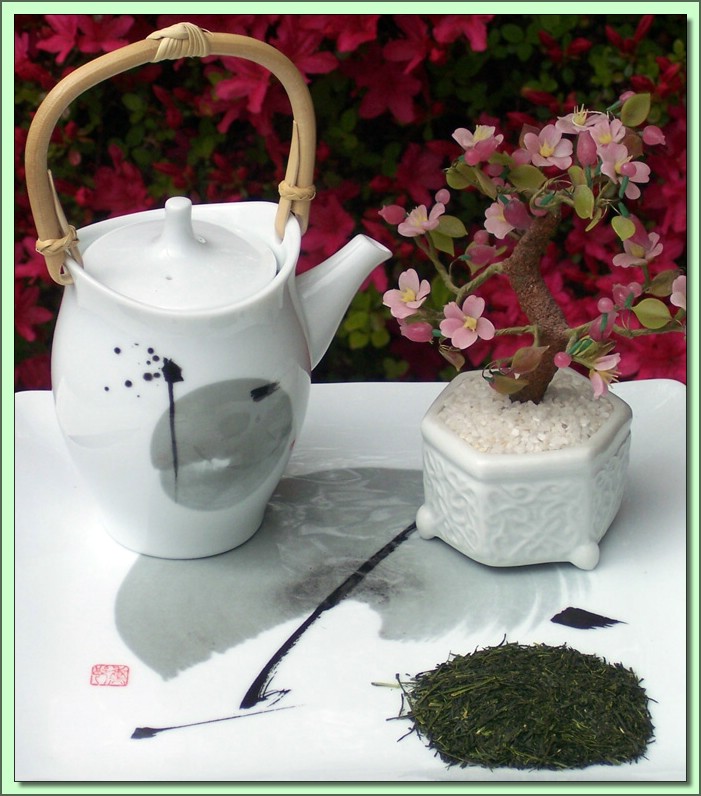
A first flush soft bud harvest from the Kagoshima region. It gets its distinctive aromatic character from the rich volcanic soil. Shincha has a fresh, lively taste that is sweeter with more catechin and theanine. Purchase 2 bags using coupon code SHINCHA6 and each bag costs only $19.99 (13% off).

SHUNTA TEAPOT
12.25oz/$54.99
Silver needle white tea
BUY IT HERE!

Delicate cherry blossom design overlayed on a black matt background make this attractive tea pot stand out. A limited edition Japanese artisan collection.


Our new look for the new year! It combines ease of navigation with what we feel is a pretty attractive site and newsletter. What we haven't changed are our excellent teas (although we have added a few new ones)... Lots of new medical research this month:

SPECIAL DISCOUNTS AVAILABLE EXCLUSIVELY FOR NEWSLETTER READERS
(available until the end of September)
A subtle green tea sencha with a rich taste. Young buds are shaded in the manner that Gyokuro is processed to increase the tea's amino acid and theanine content which gives it a sweeter taste.


Midori-1200
-- Get 18% off the price of Midori 1200 if you buy two packs using coupon code: Midori-1200 (while supplies last).
Part of the Japanese limited edition artisans collection. This pot features a beautiful caligraphic pattern featuring trees around a village in on a deep read background. With Ita-ami Filter.

F5675 Red Caligraphy teapot. 15% off the $28.99 price if you use coupon code: RCTEAPOT (while supplies last).
Part of the Japanese limited edition artisans collection. This pot features a beautiful caligraphic pattern featuring trees around a village in on a deep read background. With Obi-ami Filter.

391 Hakuyo teapot. 15% off the $49.99 price if you use coupon code: 391TPOT (while supplies last).

**NEW Green Tea Community at Care2**
Greentealovers.com
has partnered with Care2.com, the largets progressive network on the Internet to develop a new greentea community forum offering advice, research and discussion. please do check it out **HERE**.

Green Tea Shown to Possess Antitumor Effect in Breast Cancer

01/12/2007


A team of scientists led by Dr. Radha Maheshwari, professor of Pathology at the Uniformed Services University of the Health Sciences (USU) and Rajesh Loganathan Thangapazham, a graduate student, have shown that green tea has antitumor effect in breast cancer cells. The recently concluded study will be published in the Journal of Cancer Biology and Therapy, December 2007, Volume 6, Issue 12.

Cancer is a disease caused by the increased proliferation of cells which group and form a lump called tumor. Tumors can be benign or malignant. Cells from malignant tumors break away from the original tumor and spread to other parts of the body growing and forming new tumors. They can invade, penetrate into blood and lymphatic vessels, circulate via the bloodstream and can grow in a normal organ or tissue anywhere in the body. Unfortunately treatment options for metastasis are very limited and usually represent the end stage of the disease.Unlike malignant tumors, benign tumors do not invade and, with very rare exceptions, are not life threatening. Chemoprevention broadly implies the use of a chemical substance of either natural or synthetic origin, to prevent, hamper, arrest or reverse a disease. Phytochemicals are plant based non nutritive components with substantial medicinal properties.

Dr. Maheshwari’s study observed that green tea can inhibit the invading capacity of these breast cancer cells and have also identified the mechanisms involved in death inducing and invasion inhibiting effects of green tea. Epidemiological studies also suggest that the risk of breast cancer is found to be less in Asian countries consuming green tea. These studies have greater clinical significance since the ability of these phytochemicals to activate anti-cancer program of tumor cells might determine the success of chemotherapy.

A study by Dr. Maheshwari that was published earlier this year in Cancer Letters showed that green tea is effective in delaying tumor incidence as well as in reducing the tumor burden. Green tea was found to inhibit growth of tumors as well as induce death of breast cancer cells.

REFERENCE
http://www.newswise.com/articles/view/
535983/

Citrus Juice, Vitamin C Give Staying Power To Green Tea Antioxidants

11/14/2007
ScienceDaily

To get more out of your next cup of tea, just add juice.

A study found that citrus juices enable more of green tea's unique antioxidants to remain after simulated digestion, making the pairing even healthier than previously thought.

The study compared the effect of various beverage additives on catechins, naturally occurring antioxidants found in tea. Results suggest that complementing green tea with either citrus juices or vitamin C likely increases the amount of catechins available for the body to absorb.

"Although these results are preliminary, I think it's encouraging that a big part of the puzzle comes down to simple chemistry," said Mario Ferruzzi, assistant professor of food science at Purdue University and the study's lead author.

Catechins (pronounced KA'-teh-kins), display health-promoting qualities and may be responsible for some of green tea's reported health benefits, like reduced risk of cancer, heart attack and stroke. The problem, Ferruzzi said, is that catechins are relatively unstable in non-acidic environments, such as the intestines, and less than 20 percent of the total remains after digestion.

"Off the bat you are eliminating a large majority of the catechins from plain green tea," Ferruzzi said. "We have to address this fact if we want to improve bodily absorption."

Ferruzzi tested juices, creamers and other additives that are either commonly added to fresh-brewed tea or used to make ready-to-drink tea products by putting them through a model simulating gastric and small-intestinal digestion. Citrus juice increased recovered catechin levels by more than five times, the study found. Ascorbic acid, or vitamin C, used to increase shelf life in ready-to-drink products, increased recovered levels of the two most abundant catechins by sixfold and 13-fold, respectively.

The study, published this month in Molecular Nutrition and Food Research, also found that soy, dairy and rice milk appeared to have moderate stabilizing effects. But Ferruzzi said the result is misleading; a chemical interaction between milk proteins and tea catechins apparently helps shelter the complex from degradation, a force likely overcome by enzymes within a healthy human digestive system.

Lemons and tea go even better together than their popularity might suggest. Lemon juice caused 80 percent of tea's catechins to remain, the study found. Following lemon, in terms of stabilizing power, were orange, lime and grapefruit juices. Ferruzzi said both vitamin C and citrus juices must interact with catechins to prevent their degradation in the intestines, although data made it clear that citrus juices have stabilizing effects beyond what would be predicted solely based on their vitamin C content.

"If you want more out of your green tea, add some citrus juice to your cup after brewing or pick a ready-to-drink product formulated with ascorbic acid," Ferruzzi said.

Ready-to-drink green tea products should optimally contain 100-200 mg of catechins, but oftentimes do not have sufficient levels of tea extract since some people do not like green tea's flavor, Ferruzzi said.

Although this study only examined green tea, Ferruzzi said he suspects that some of the results also could apply to black tea, which is produced by fermenting green tea. Many prefer black tea's flavor, although it contains lower total levels of catechins.

Studies have shown catechins from the green tea plant, Camellia sinensis, are able to detoxify toxic chemicals, inhibit cancer cell activity and stimulate production of immune-strengthening enzymes. Finding methods to improve uptake of these catechins may, therefore, be important in improving health, part of the study's goal, Ferruzzi said.

Ferruzzi currently is conducting an in vivo study, or study on a live organism, to quantify the ability of juices and vitamin C to increase levels of catechins in the intestines and bloodstream of animals and, by extension, in humans. He collaborates with the NIH-funded Purdue Botanicals Research Center on this project.

"This next study is designed to get us past the limitations imposed by our digestive model, which is really just a simple screening process that relies on preset physiology parameters," he said. "Human digestion is a lot more complicated."

To see if juices and vitamin C actually increase catechin absorption, researchers will have to find out if increased levels of intestinal catechins translate to higher levels of absorbed catechins in live animals and humans. They also will need to better document effects upon catechin metabolism in order to prove, for instance, that increased levels of absorbed catechins are not leveled off by metabolic factors, Ferruzzi said."This study tells us a lot of interesting things, but it raises many questions that have yet to be answered," he said.

The study was funded by the National Institutes of Health. Adapted from materials provided by Purdue University.

REFERENCE
http://www.sciencedaily.com/releases/2007 /11/ 071113163016.htm

In the laboratory, green tea proves a powerful medicine against severe sepsis


MANHASSET, NY – A major component of green tea could prove the perfect elixir for severe sepsis, an abnormal immune system response to a bacterial infection. In a new laboratory study, Haichao Wang, PhD, of The Feinstein Institute for Medical Research, and his colleagues have been studying the therapeutic powers of dozens of Chinese herbal compounds in reversing a fatal immune response that kills 225,000 Americans every year. They found that an ingredient in green tea rescued mice from lethal sepsis – and the findings could pave the way to clinical trials in patients.

The study was published this week in the Public Library of Science, or PLoS-ONE. Dr. Wang had previously discovered a late mediator of sepsis called HMGB1, a substance expressed in the late stages of lethal sepsis. They wanted to figure out a way to block this substance, which they felt would prevent the lethal sepsis process from moving forward. And it worked.

Scientists worldwide have been stumped by sepsis. Even with the most advanced medical techniques available, half of those who develop sepsis die of the massive assault on the body. Several laboratories at the Feinstein Institute are working on sepsis – both on the basic biological level and in patients.

In the latest study, Dr. Wang’s group gave a substance in green tea called EGCG to mice in the throes of severe sepsis. The dose was equivalent to 10 cups in a human. Survival jumped from 53 percent in those who didn’t receive the green tea substance to 82 percent in those who did. “Clinically, even if we could save five percent of patients, that would be huge,” said Dr. Wang. “In this study, we saved 25 percent more animals with the green tea.” He said that the green tea component, EGCG, is readily available.

There have been more than 100 papers focusing on this natural substance and its anti-cancer benefits. “This compound prevents HMGB1 from being released by immune cells and it also prevents it from activating immune cells to produce more cytokines,” he said. Cytokines are produced by immune cells and act as weapons to defend the body against invaders. “We are hoping to stimulate future interest in clinical studies,” said Dr. Wang, who worked on the study in collaboration with Wei Li, PhD, Andrew Sama, MD, chairman of emergency medicine at North Shore University Hospital, and other Feinstein investigators.

REFERENCE
http://www.eurekalert.org/pub_releases/2007-11/nsij-itl110807.php

Green tea can combat TB: LU research team

10/13/2007
Lucknow

Researchers at the Biochemistry department of Lucknow University claim to have clinically proven that green tea can efficiently combat tuberculosis (TB).

“Our studies, followed by clinical trials on animals, have shown that green tea is immensely beneficial for TB patients. A variety of compounds found in green tea can fight Mycobacterium Tuberculosis, the bacterium which causes the disease,” said Professor M K Misra of Biochemistry department.

The researchers said toxins produced in a TB-infected mice showed a considerable fall after they had been administered green tea extract for seven days. “It was heartening to see the level of antioxidants, which had been lowered by the infection, revert to near-normal levels,” said the researchers, who were assisted by doctors of CSMMU during the clinical studies.

The researchers explained that during the infection Mycobacterium Tuberculosis targets the blood cells in the human body, lowering its immune system. This, in turn, triggers formation of several toxins inside the body. Green tea extracts control the growth of bacterium, helping the human body’s immune system to recover gradually.

They said since green tea undergoes minimal oxidation during processing, compounds like catechins, flavanoids and phenols do not lose their original nature. “These compounds, which make green tea so special, are responsible for controlling the growth of the bacterium,” said Professor Misra.

Significantly, studies conducted by LU researchers on the healing effects of green tea extract have been published in Molecular and Cellular Biochemistry of The Netherlands. “We made this breakthrough after working for over five years and our work has put the university on the international map,” said Misra.

The research team said they are working extensively with other types of teas to explore their potential healing effects.

“We will carry out a similar series of experiments and studies with other varieties of tea,” said a member of the university research team.

http://www.expressindia.com/latest-news/Green-tea-can-combat-TB-LU-research-team/231111/

Inhibition of colorectal tumorigenesis in azoxymethane (AOM)-treated rats by green tea polyphenols.


Elucidating a decade’s worth of conflicting studies of the cancer-fighting benefits of green tea, researchers at Rutgers University have conclusively demonstrated that a standardized green tea polyphenol preparation can prevent the growth of colorectal tumors in a rat model of human colorectal cancer.

Results from previous studies using different tea constituents in this particular rat cancer model, which is thought to closely mimic human cancer, had been inconsistent. The researchers believe their findings will pave the way for clinical trials with green tea polyphenols in humans.

“Our findings show that rats fed a diet containing Polyphenon E, a standardized green tea polyphenol preparation, are less than half as likely to develop colon cancer,” said Hang Xiao, Ph.D., research associate at the Department of Chemical Biology in Ernest Mario School of Pharmacy of Rutgers University.

According to Xiao, these results are consistent with previously published results by the project’s primary investigator, C.S. Yang, Ph.D., professor and chair of the Department of Chemical Biology at Rutgers, which showed that green tea consumption was associated with lower colon cancer rates in Shanghai, China.

Xiao and his colleagues treated two groups of mice with azoxymethane (AOM), a widely used agent that has been shown to generate in rats colorectal tumors that share many characteristics with colorectal cancer in humans, Xiao says. They then split the rats into two groups that were each fed a high fat diet, which the researchers believe closely resembles a Western diet; half received a 0.24 percent solution of Polyphenon E. According to Xiao, the green tea extract contains four major polyphenols, the majority of which (about 65 percent) is EGCG, thought to be the main active ingredient.

“When you account for caloric consumption, 0.24 percent Polyphenon E in diet gave the experimental rats the equivalent of about four to six cups of tea a day,” Xiao said. “While I can’t make any recommendations for how much green tea people should drink each day, it isn’t uncommon for some to drink that much tea.”

After 34 weeks, rats that received Polyphenon E developed 55 percent fewer tumors compared to the control rats that did not receive Polyphenon E. Moreover, the tumors were 45 percent smaller in rats treated with green tea extract. Histopathological analysis by his colleague, Xinpei Hao, Ph.D., also showed that the treatment group had significantly lower incidence and number of malignant colon tumors. The researchers could also detect green tea polyphenols in the blood plasma as well as the colorectal mucosa of the rats who received the extract.

Meanwhile, the test rats weighed about five percent less than their control group counterparts, a result Xiao attributes to the ability of the green tea polyphenols to block lipid absorption in the body, which the researchers had previously demonstrated in a mouse model of obesity.

REFERENCE
http://www.newswise.com/articles
/view/535657/

THE COMPLETE TEA SHOP
Featuring our fine white & green teas, teaware, tea extract, skin care, plants, books & filters.

Ordering & Shipping Info
Our SECURE shopping cart accepts multicurrency, credit cards & paypal.

image spacer


And Find us on:

image spacer

© 2005 Greentealovers.com -- info@greentealovers.com
850 Napoleon St., Woodmere, NY 11598 / Tel: 516-374-6538 (Phone/Fax)