|
|
Please Review the certifications of our various tea and tea ware products below. They represent our commitment to bring you the finest, healthiest tea products. We use a single Japanese Producer (Ito En) for the vast majority most of our Japanese green tea and a US/Canadian Based producer for all teas outside Japan (Metro Tea) and some Japanese teas.
|
|
C-TPAT
As detailed by the US Deptartment of Homeland Security our manufacturer's adhere to C-TPAT policies as outlined by US Customs and Border Protection.
|
|
ISO 14001 certification
Our Japanese tea producer (Ito En) and its estates conform to the most rigorous environmental and safety standards. In Dec. 2000, it became the first Japanese tea producer to acquire ISO 14001 certification
|
for environmental management systems. It conducts an environmental protection program on a continuous basis as an integral part of its business activities. All its major tea production facilities acquired certification for implementing ISO 14001 management systems, as well as increasing environmental awareness among employees. Learn more of Greentealover's environmental commitment here.
|
Rigorous Inspection in Japan - In addition to its ISO certification and all its imported products needing to meet FDA requirements, our Japanese producer's green tea products must meet the standards of its own food safety agency, the
|
Ministry of Health and Welfare Food Sanitation Division. Food safety is a particularly delicate issue in Japan, which imports 60 percent of its food supply. How strict and good are Japanese food safety practices? Citing the Food and Drug Administration, the US House of reprersentatives report described Japan’s model as the most realistic one for protecting American consumers. “The Japanese system of regulating Chinese food imports appears to offer better control than that currently used by F.D.A.,” it concluded.
READ ABOUT OUR CURRENT POLICY WITH JAPANESE TEA POST-FUKUSHIMA AND OUR VENDOR'S GUARANTEE.
|
HACCP (Hazard Analysis Critical Control Points) HACCP is an international food safety program that is now THE gold standard for the best food manufacturing facilities on the planet.
|
HACCP was developed for the NASA space program. Compliance is assured by an annual audit. Metropolitan Tea is HACCP compliant. HACCP Analyzes the food product cycle from raw ingredient stage to the finished product. Our Producer passed a rigorous 2-year process to obtain HACCP certification.
It is audited annually to ensure all processes and documentation is maintained. Products are produced on tea gardens that conform to the lowest MRL (minimum residue levels) for approved agricultural inputs for tea. Our producer assists our major producers in compiling MRL's from North America, Europe, UK and Australia which are then used by food scientists at Cambridge University to construct matrices identifying the lowest MRL's combined with the least harm to the environment.
|
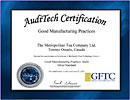
GMP (Good Manufacturing Process) is an additional food safety program governing the manufacturing policies of Metropolitan Tea for compliance - from employee hygiene to facility traffic flow and allergen control. Compliance assured by annual audit.
|
|
Click to Enlarge |
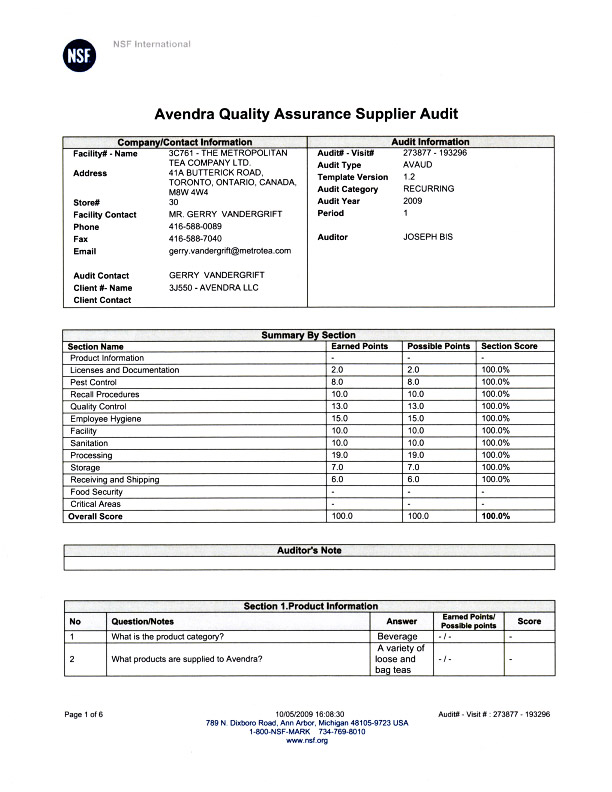
Avendra
The gold standard of Supply Chain Management and Procurement is set by Avendra. Metropolitn Tea Compliance is assured by an annual audit.
|
NSF International is a 3rd party auditor acting on behalf of Avendra to test compliance of Avendra's ultra strict food safety guidelines.
|
USFDA/CFIA/EFSA Certifications - Health and safety issues for imported
goods, particularly from China have been in the news.
We take these measures to insure your health and safety:
|
All Tea products conform to the rigorous standards of one or more of the following agencies.
• USFDA (U.S. Food and Drug Administration)
• CFIA (Canadian Food Inspection Agency)
• EFSA (European Food Standards Authority)
USFDA must approve the importation of all tea products before they are allowed into the US. Tests are conducted for any and all contaminants by recognized agencies at levels higher than Health Canada and the USFDA require. Every lot of tea and herbs received and packed in warehouse is tasted and tested a minimum of 5 times to ensure all tea is free from contaminants from non-tea input.
For tea ware our producer uses 18/8 grade stainless steel exclusively in all metal products – infusers, strainers, teapots, etc. This grade has been approved safe by the agencies above.
|
Organic Certifications -
Our organic teas have official certifications from a variety of sources including the USDA, European and Japanese agricultural authorities. The certification body and ID# are listed after each organic tea.
|
|
Click to Enlarge |
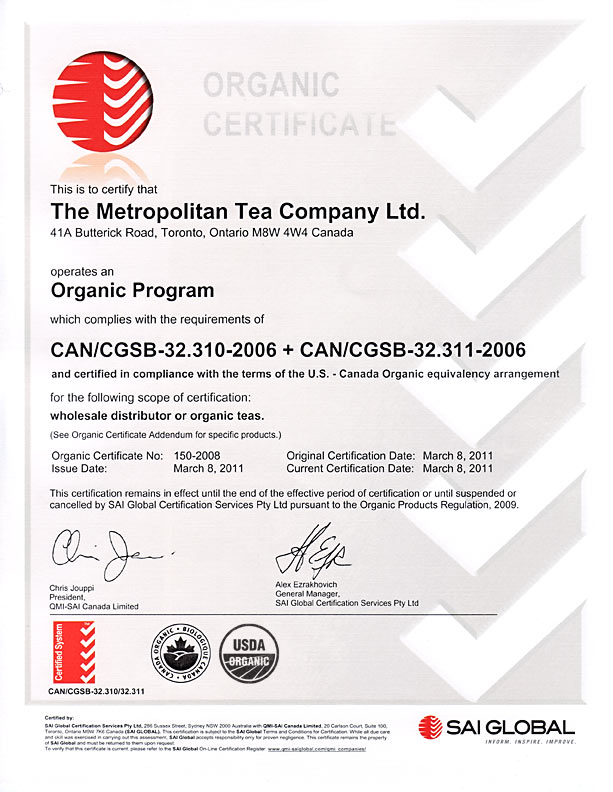
NOP - USA - Organic
Metropolitan Tea is a USDA NOP Certified, Organic Food Handler and Tea Supplier. All of our organic products are certified 100% organic and are grown with no conventional pesticides, petroleum based fertilizers or sewage-sludge fertilizers.
|
|
Click to Enlarge |
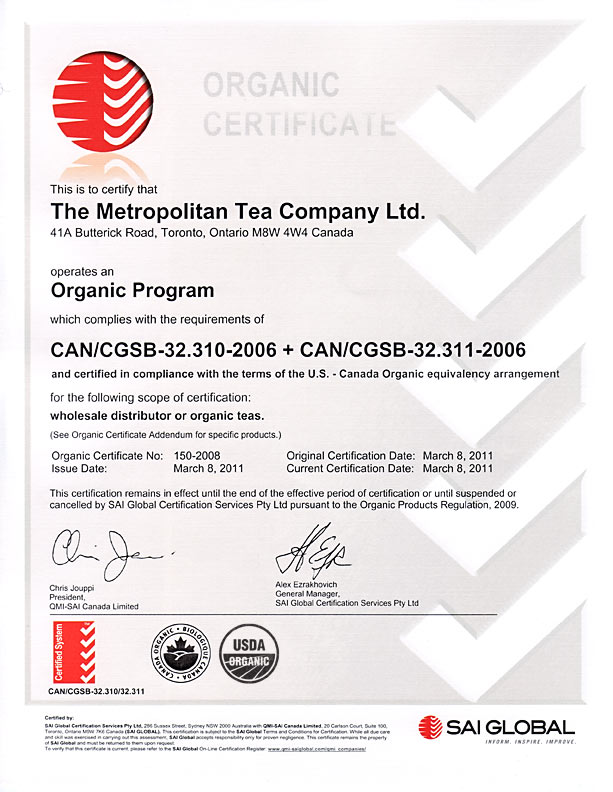
COR - Canada- Organic
Metropolitan Tea is a CFIA COR Certified Organic Food Handler and Tea Supplier. All of our organic products are certified 100% organic and are grown with no conventional pesticides, petroleum based fertilizers or sewage-sludge fertilizers.
|
|
|
EU Organic
Metropolitan Tea is an Organic Farmers and Growers (OF&G) Certified Organic Food Handler and Tea Supplier. All organic products are 100% certified organic - grown with no pesticides, petroleum or sewage-sludge fertilizers.
|
|
Tea Association of the USA - As a member of the Tea Association of the USA since 1991, Metropolitan Tea is committed to furthering the interests of tea retailers and the tea industry in general both in the US and abroad.
|
|
Tea Association of Canada - Metropolitan Tea is an active member of the Tea Association of Canada since 1991. TAC works toward strengthening and supporting the Canadian and global tea industry.
|
|
Fair Trade Certification & Commitment - Our African greens tea and estates are fair trade certified conforming to the highest labor and environmental standards. Fair Trade is a product certification system designed to identify
|
products that meet agreed environmental, labor and developmental standards. Overseen by a standard-setting body, FLO International, and a certification body, FLO-CERT, the system involves independent auditing of producers to ensure the agreed standards are met. Companies offering products that meet the Fairtrade standards may apply for licences to use the Fairtrade Certification Mark (or, in North America, the applicable Fair Trade Certified Mark) for those products. Click here For more information.
|
The Ethical Tea Partnership (ETP) - works to monitor living and working conditions on tea estates, to make sure the tea you buy from ETP members has been produced in a socially responsible way. ETP members
|
share responsibility for the social and ethical conditions involved in sourcing the tea they buy.
ETP's monitoring program is thorough and credible. Monitoring is carried out on a rolling basis, with a full monitoring visit carried out on an estate every four years. Pricewaterhouse Coopers have been ETP's monitors since 2002.
ETP monitors against six areas: Employment (including minimum age and wage levels), Education, Maternity, Health and Safety, Housing and Basic Rights checking compliance with local laws and union agreements and some international standards.
The Following Areas are Monitored:
- Employment is freely chosen
- Freedom of association and collective bargaining rights are respected
- Working conditions are safe and hygienic
- Child labour shall not be used
- Total remuneration packages are negotiated between unions and employers
- Agreements in place regarding working hours
- No discrimination is practiced
- No harsh or inhumane treatment is allowed
There are three stages of monitoring:
- Questionnaire
- Monitoring Visit
-
Grading
Full information about how the grading system works can be downloaded at the ETP site. An overview of the ETP monitoring process can be found here. |
|
Annual Tea Estate Quality Control Visits - Annual visits to growers on all continents are essential to ensure that acceptable standards of manufacturing safety are adhered to.
|
This has been its policy for 30 years. If a visit to a grower raises questions regarding food safety, and these questions can’t be answered properly or compliance assured, the grower is dropped from the supplier list.
|
Tea Research -
Our Japanese producer conducts a wide variety of research to maintain and improve production and product quality. It strives to improve processing raw materials and blended ingredients.
|
1. Central Research Institute
Its Central Research Institute concentrates on medium- to long-term activities involving utilization of the active ingredients of tea leaves and developing a variety of new technologies to ensure the safety of food products.
2. The product development division
The product development division handles short-term R&D utilizing production and agricultural technologies to develop new products and improve existing ones. R&D activities have long focused on the functions of primary compounds found in green tea.
The producer formed alliances with research institutes both doestically and overseas. These include a project on the anti-senility properties of tannin with the Neurology Department of Tokyo University, and an investigation of ways to counter the toxicity of dioxins in a joint effort with Kobe University. Overseas, our producer extends support for clinical testing conducted at the University of Texas M.D. Anderson Cancer Center, a leader in cancer research in the U.S., on the possible cancer-prevention properties of catechin found in green tea.
3. High Antioxidant Testing
The producer of our non-japanese teas tests for antioxidant content at the Univeristy of Toronto.
|
Our tea and tea ware have a variety of certifications:
Learn More about...
|
Our SECURE shopping cart accepts multicurrency, credit cards & paypal.
|
|